
I Passed Claude Certified Architect Professional with 970/1000
On October 31, 2026, I passed the Claude Certified Architect - Professional (CCAR-P) examination with a score of 970/1000, against a passing threshold of 720. I am happy with the result. What stayed with me, though, was how much of the examination came back to architectural judgment.
My work spans AI/ML engineering, MLOps, LLMOps, cloud infrastructure, and GenAI applications. Across those areas, the difficult part is often taking a promising demonstration and turning it into something a team can operate: with a latency budget, a cost ceiling, clear permissions, and a way to tell when quality has slipped.
I took this certification to examine those decisions through the Claude ecosystem. This is my experience of the exam and the engineering principles I took from it.
The result and the credential
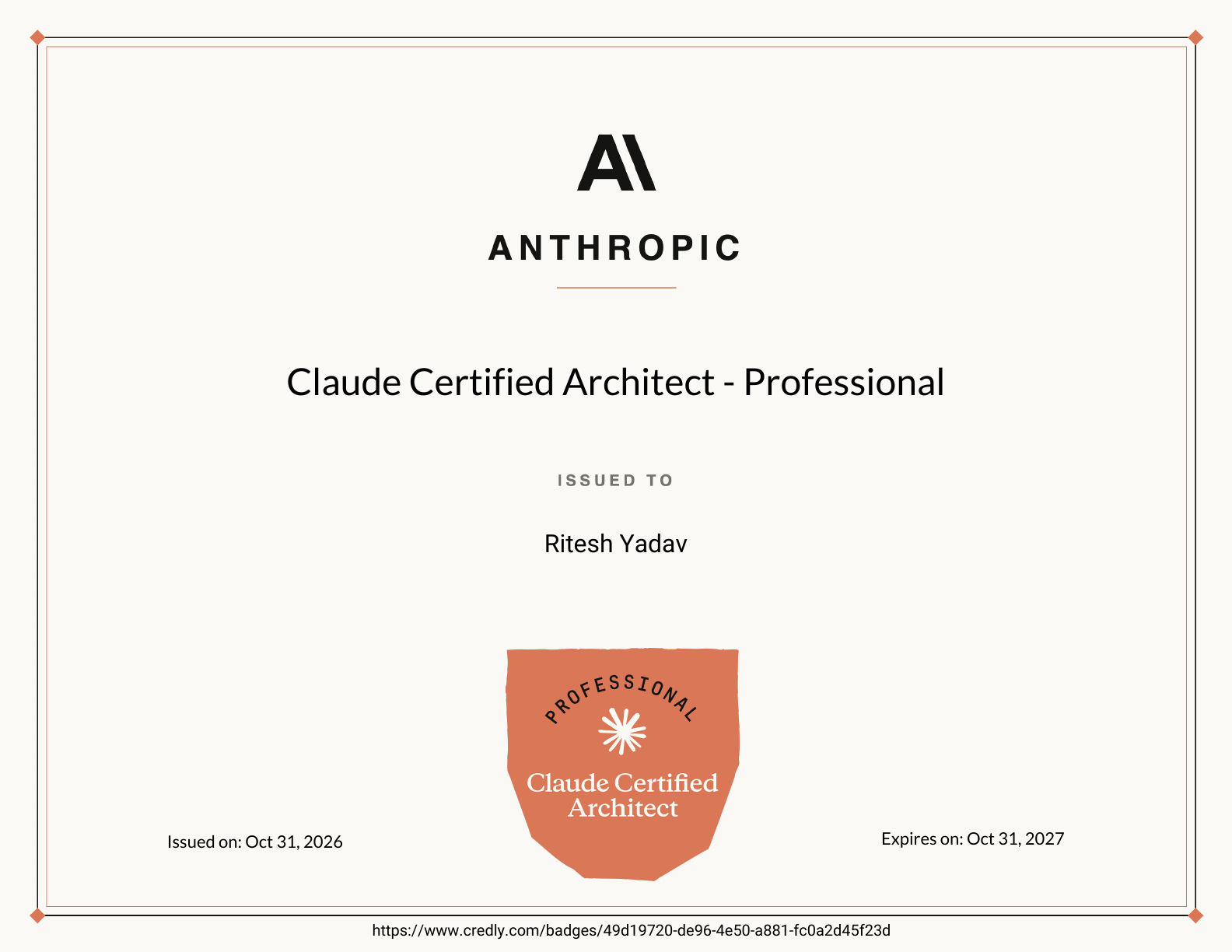
View my credential on Credly · Open the original certificate PDF
The certificate records the credential and its validity dates. My examination score was 970/1000. Anthropic reports results on a scaled score range of 100 to 1,000, so I would not interpret 970 as a percentage of questions answered correctly. The certification FAQ explains the scoring system and passing threshold.
Why the architecture focus mattered to me
I expected to need detailed knowledge of APIs, SDKs, tool use, MCP, RAG, context engineering, Claude Code, Skills, and evaluation. Those technical foundations mattered. What I found particularly interesting was the emphasis on choosing an approach under business and operational constraints.
In my sitting, the scenarios asked me to weigh model capability against cost, predictable workflows against autonomous agents, and integration choices against security and maintenance requirements. They also brought in customer expectations and the responsibility to explain a trade-off clearly.
That feels close to real architecture work. A customer may ask for an autonomous agent when a controlled workflow would meet the need more reliably. A larger context window may accommodate more information while leaving the underlying retrieval problem unresolved. A technically possible design may still miss the latency or budget requirement.
Anthropic describes the Professional credential as covering enterprise integration architecture, governance, and evaluation. My experience was consistent with that scope.
The blueprint I prepared against divided the material into seven domains:
| Domain | Weight |
|---|---|
| Solution Design & Architecture | 17% |
| Claude Models, Prompting & Context Engineering | 13% |
| Integration | 19% |
| Evaluation, Testing & Optimisation | 16% |
| Governance, Safety & Risk Management | 14% |
| Stakeholder Communication & Lifecycle Management | 14% |
| Developer Productivity & Operational Enablement | 7% |
Integration had the largest share. To me, that weighting reflects where much of the engineering effort lives: connecting a capable model to the rest of an organisation safely and reliably. For current exam scope and preparation material, use the Professional certification page and its exam guide.
Six decisions I would carry into a design review
Keep application responsibilities explicit
Consider an enterprise assistant that reads a customer request, retrieves internal information, and recommends an action. Before choosing a model, I want to know which decisions belong to the application, which need model reasoning, and which need human approval.
Business rules, access checks, financial calculations, and schema validation need appropriate deterministic controls. The model can interpret a request or propose an action; the surrounding services still own the rules for accepting and executing it.
That boundary also gives the team somewhere to put retries, timeouts, state management, and audit records. A good prompt cannot carry all of those responsibilities.
Choose the amount of autonomy the task needs
A document pipeline with known stages, extraction, classification, retrieval, validation, and response generation, is a good candidate for a workflow. Its transitions can be defined in advance.
A support task may require more flexibility: choose a tool, inspect the result, decide what information is missing, and take another step. An agent can be useful when that sequence cannot be specified upfront. Anthropic's explanation of workflows and agents makes this distinction clearly.
For multi-agent designs, I would want an explicit reason for delegation. Independent work or separate context requirements can justify it. Each additional agent also brings more model calls, state, coordination, and failure paths. The design needs to earn that complexity.
Treat context as a resource
Context engineering asks what information the model needs at each step, how it is selected, and what should survive into the next step.
An agent with 30 tools does not necessarily need every tool's complete documentation in every request. I would consider scoped tool sets, progressive discovery, selective retrieval, and explicit token budgets. Conversation history and intermediate results need the same attention.
Prompt caching can reuse stable prompt prefixes and reduce repeated processing. I would still measure cache usage, end-to-end latency, and cost per completed task. A caching feature is useful when the actual request pattern benefits from it.
Separate integration from authorisation
MCP, direct APIs, SDKs, and CLI integrations solve different integration needs. I would choose based on the interface being exposed, who owns it, how it will be reused, and what the team can operate.
The MCP architecture documentation describes how applications connect to servers exposing capabilities such as tools and resources. That protocol boundary does not replace the application's permission checks.
An assistant might discover a refund tool while the current user only has permission to read an order. The service executing the refund must enforce the user's authority, validate the arguments, and apply any required approval. Making a capability visible and allowing an action are separate decisions.
Evaluate the complete task
Model response quality is one measurement. For a production application, I also want to know whether the right information was retrieved, the right tool was selected, the action succeeded, and the user received a useful result.
My evaluation plan would combine curated offline cases, regression checks, human review where judgment is subjective, and production monitoring. Prompt, model, retrieval, and tool changes should be assessed against the same task-level expectations.
The measurements need to include correctness, latency, token consumption, cost per task, failure rates, and security boundaries. Traces should explain which model calls and tools contributed to the outcome. Otherwise, a slow or incorrect response gives the team very little to investigate.
Make governance part of execution
For me, enterprise readiness means least-privilege access, input and output validation, prompt-injection defences, sensitive-data handling, auditability, and clearly placed human approvals.
An agent that retrieves financial information should not acquire transaction permissions simply because the same workflow could benefit from them. Reading data, recommending an action, and executing that action deserve separate controls.
Stakeholder communication belongs here too. Someone needs to explain what the system can do, where uncertainty remains, who owns exceptions, and what happens when a service fails. Those conversations determine whether the design can be supported after launch.
What my score report told me
My report showed 100% on many individual objectives, including architecture and orchestration, model selection and prompt reuse, authentication and authorisation, evaluation, safety, stakeholder communication, and developer productivity.
Two objectives stood out as areas to revisit:
| Objective | Reported result |
|---|---|
| Tool and agent configuration for capability bloat | 67% |
| Supporting debugging and operational issue resolution | 50% |
These are objective-level results from my report, rather than weighted domain scores or a measure of production proficiency. I found the breakdown more useful than the total alone: it gives me specific areas to examine in my next round of practical work.
Capability bloat and operational debugging are closely connected to the concerns above. How many tools does an agent really need? Can an engineer reconstruct what happened when it failed? I want those answers to be clear in systems I build.
Where I place certifications in an engineering career
I value a certification as a structured check of platform knowledge and architectural understanding. Preparing for one makes me revisit areas I might otherwise leave outside my day-to-day work.
Hands-on delivery tests a different set of abilities. Designing an agent on paper is one exercise; keeping it reliable under concurrent requests, rate limits, partial failures, and changing upstream services is another. Understanding evaluation methods also differs from maintaining a regression suite that catches meaningful problems across model and prompt changes.
The same applies to explaining trade-offs. An architect needs to justify a design in terms the team and customer can act on: expected quality, latency, cost, security, implementation effort, and operational ownership.
I see this result as a useful milestone within that larger body of work.
What I want to explore next
I appreciate Anthropic's investment in structured learning for developers and architects. The Claude cookbooks and platform documentation are useful companions to certification preparation. As a reader, I would welcome even more worked examples that track the platform's newer capabilities.
I am also considering Claude Certified Developer - Foundations. Alongside that, I want to keep building and examining agentic systems, secure MCP integrations, context strategies, retrieval pipelines, and evaluation infrastructure.
The score is a result I am pleased with. The professional standard I want to keep working towards is broader: design the system, explain its trade-offs, implement it, and make it possible for a team to keep it working.
About the author
Ritesh Yadav works as an AI/ML Engineer. He writes independent research notes on ML performance, infrastructure, and systems, covering CUDA, low-latency inference, generative AI, distributed training, Kubernetes, and LLMOps.